- Best Neighborhoods in Madrid to Stay for First Timers: Centro, Retiro
If it’s your first time in Madrid, odds are you’re here to check out its main attractions. Centro is ideal for visiting the Royal Palace and for exploring the medieval streets around Plaza Mayor, while Retiro is perfect for visiting the three world-class art museums and Madrid’s most impressive park. Centro and Retiro a 20-minute walk (or short metro ride) apart, so you can stay in either neighborhood and catch all the main sights. That said, there is some advantage to staying in Centro over Retiro: its proximity to Madrid’s nightlife, both north and south of the center, and a wealth of accommodation to suit any budget. - Best Neighborhoods in Madrid for Sightseeing: Centro, Retiro
Since most of Madrid’s main attractions are centrally-located and within easy walking distance of one another, it makes sense to stay either in Centro or in Retiro, depending on whether you’re more interested in being close to the Royal Palace (Centro) or the ‘Golden Triangle’ of art museums (Retiro). But you needn’t limit yourself just to these two neighborhoods; you can easily reach the attractions of either on foot from La Latina, Chueca, and other central barrios. - Lavapiés and Anton Martin - a diverse and multinational neighbourhood, it offers cheaper accommodation options close to downtown and the opportunity to experience Madrid as locals do
some advantage to staying in Centro over Retiro: its proximity to Madrid’s nightlife, both north and south of the center, and a wealth of accommodation to suit any budget.
- Best Neighborhood in Madrid for Walking: Centro
You’ll find some of Madrid’s most beautiful architecture in Centro, and its tiny, charming medieval streets are an absolute joy to wander. That said, Madrid’s city center in its entirety, from La Latina to Retiro, is best explored on foot. - Unsafe Areas of Madrid
Parts of Malasaña, Centro, La Latina, Lavapiés, and Huertas can be a bit sketchy at night; it’s best to stick to popular and well-lit streets with plenty of foot traffic and avoid poorly lit, deserted ones. At night, it’s best to avoid the area south of Lavapiés, around the Atocha train station, as well as any deserted parks. Opportunistic pickpockets operate at the El Rastro flea market in La Latina and Lavapiés on Sundays. 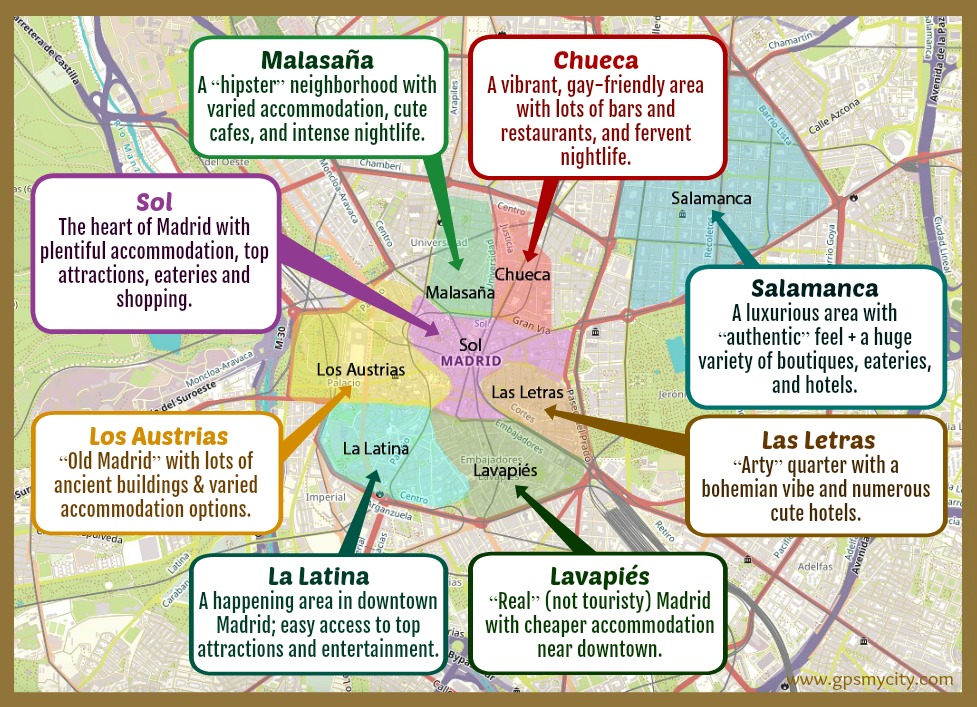

The Mercado de San Miguel is the ideal place to enjoy an authentic gourmet experience in the center of Madrid
main museums in Madrid:
- Prado Museum: Free admission from Monday to Saturday from 6:00pm to 8:00pm, and Sundays and holidays from 5:00pm to 7:00pm. It is located at Paseo del Prado and you can take the metro (Atocha, Line 1 y Banco de España, Line 2).
- Reina Sofía Museum: Is located on Calle Santa Isabel, 52 (metro Atocha, Line 1 y Lavapiés, Line 3). Free admission from Monday to Saturday (except Tuesdays), from 7:00pm to 9:00pm and Sundays and holidays from 1:30pm to 7:00pm.
- Thyssen-Bornemisza Museum: Is located at Paseo del Prado, 8 (metro Banco de España, Line 2). Free admission on Monday from 12:00pm to 4:00pm.
- Sunday mornings in Madrid would not be the same without the Rastro. A market in the open with hundreds of booths where you can buy anything from antiques, to second-hand furniture and even trade cards.
If you are a sunset lover, one of the best is located at the rooftop of the Círculo de Bellas Artes. You have perfect panoramic views of the Gran Vía and Alcala streets and of the entire north side of the city.
you find the Egyptian beauty in the center of Madrid. The Temple of Debod is surrounded by a park and by one of the best panoramic views of the Almudena Cathedral.
My recommendation is to start the trip from Plaza de España and enjoy everything from Madrid architecture to the Plaza de Cibeles. It is an unforgettable walk of almost 2 kilometres.
Moreover, the official price of entry to the Palacio de Cibeles (on the picture above) is 2 euros (which is very cheap anyway), but I don’t remember paying anything there, maybe you only need to pay to go to the roof.
Food in Spain is not expensive at all, moreover, there are lots of fast foods and tapas bars with Spanish cuisine that are also very cheap, so trying to save money, you can always eat out instead of cooking at your apartment or hostel
As a big exporter of fruits and vegetables, Spain has very low prices for such products during the harvest season. So, you often can buy apples, oranges, zucchini and tomatoes for just 1 euro per 2 kilos (if you need that much).
Great places to eat some tapas are 2 chains: ‘100 Montaditos’ and ‘Museo del Jamon’, as well as numerous single tapas bars. One of the famous tapas bars, where you get free snacks (tapas) if you buy drinks is El Tigre. Although, the waiters were extremely impolite when I visited it.
Accommodation
|
Price (Euros)
|
| Cheapest option for 1 person |
15
|
| Cheapest option for 1 person with central location and 7+ rating (with breakfast) |
16
|
| Cheapest 3-star hotel room for 2 with central location and 7+ rating |
59
|
| Cheapest 5-star hotel room for 2 with central location and 9+ rating https://romanroams.com/en/3-days-madrid-prices-itinerary/ Madrid ‘Visit the Most’ Itinerary
Trying to cover the most of Madrid attractions, you will spend most of the time in numerous museums, cathedrals and other buildings. Here’s the plan:
The route will be similar, but a couple of new attractions will be added. When visiting the western part of Madrid, you should also go to the Plaza de España (Spanish Square) and the nearby park with the Templo de Debod.
For the second day, in addition to the 2 museums or Retiro park and Botanical garden, you have a National Museum of Queen Sofia and the Palacio de Cibeles (if you like markets, I recommend the one near Antón Martín metro station on the way to those sights).
For the third day, the route will be almost identical as before. I only recommend visiting theSan Francisco el Grande church.
One more option I recommend is to take a 2-day ticket to Madrid hop-on hop-off city tour busses, which costs just 22,5 euros if you buy online. It is an easier and more comfortable way to visit the city’s attractions.
see such wonderful monuments and sights such as the Royal Palace, the Plaza Mayor, the Almudena Cathedral, Puerta del Sol, Santa Ana Square, Gran Via, and the city's many historic buildings and squares which make this one of Europe's most attractive cities for sight-seeing.
By Budget: $$
The very best hostales will often surpass the quality of some cheaper hotels, but are simply called hostal because of the size of the rooms, the lack of an elevator or because, as mentioned above, they don't occupy the entire building. In these cases, local regulation doesn't allow them to be classified as hotels, but what they lack in name they certainly make up for in value for money.
There are 4 transportation options from Madrid-Barajas Airport (MAD) to Madrid city centre, bus, taxi, Metro and train. The most convenient option is taking aMadrid airport taxi at a cost of 30€. A cheaper option is to take the train. Tickets for the train cost 2.6€ one way, and the journey is approximately 27 minutes. Another well priced option is the metro. Tickets are 3€ one-way, and the journey only takes 22 minutes.
The Metro station is located inside the Madrid-Barajas airport with two different stations at Terminal 2 and Terminal 4.
Convenience
Located directly in the Airport, the subway is extremely easy to access. The main line that reaches Madrid-Barajas Airport is line 8. Metro line 8 is also connected with Metro lines 6,10, 9, 4, so you can actually reach the majority of Metro stations in Madrid.
The Spanish railway company RENFE, connects Madrid with the Madrid Barajas airport through the local train network service "Cercanías" C1 and C10 lines.
The train station is on the terminal T4 floor -1, and is called Aeropuerto T4.
From the airport, you can take a yellow bus known as the Express Line Atocha Renfe-Aeropuerto shuttle to Atocha railway station in Madrid, where trains will depart almost every hour of the day for Seville Santa Justa station.
Additionally, car rental rates in Spain can be rather expensive, especially for foreign drivers or during busy tourist seasons when companies raise their prices.
The most popular AVE routes go between Madrid and Seville and Madrid and Barcelona.
mentioned taking the Cercanías
trains (Renfe's commuter rail) from the airport to the train station in both Madrid and Barcelona, for sure the most direct, fastest way to get between the two. (2)
Speaking of which, I've also not seen you mention the fact that
Cercanías trips are free of charge if you hold a long-distance ticket and use Cercanías on the same date as your long-distance trip (next day for night trains). This definitely makes Cercanías the top travel option between the airport and the train station in Spain's two most populous cities. 
A single journey on public transportation in Madrid will normally only set you back between €1.50 and €2, making it incredibly budget-friendly. If you’ll be relying a lot on public transport, consider a 10-trip ticket pack. This costs just €12.20, works on both the bus and the metro, and tickets can be shared among several people. And if you’ll be in town for 24 hours, 2 days, 3 days, 4 days, 5 days, or one week, consider buying the corresponding public transport tourist pass!
You can also get to the airport via metro and cercanías. On the metro, take line 8 (the pink line), which starts at Nuevos Ministerios. Be aware that there is a special airport fare for the metro, so tickets cost slightly more than a normal ride. On the cercanías, take the C1 line, which starts at the Príncipe Pío station. Note that the cercanías only stops at terminal 4, so you’ll need to take the airport shuttle bus from there to get to any of the other terminals.
|


No comments:
Post a Comment